The Teenager in Gaming Glasses Icon: A Creative Catalyst
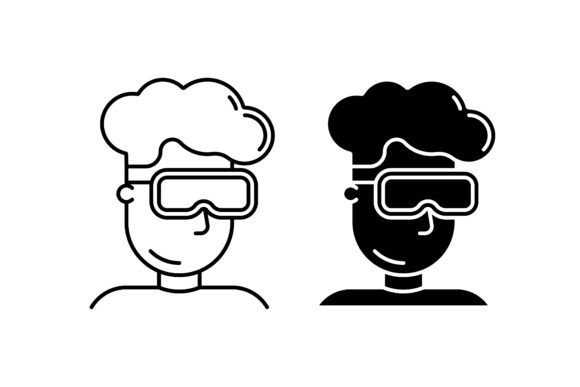
The simple linear icon of a teenager wearing 3D gaming glasses is more than just a stock graphic. It’s a cultural snapshot, a symbol of immersion, and a remarkably versatile starting point for creative projects. This black-and-white vector, isolated on a white background, presents an elegant distillation of a modern experience: the moment where a user, often a young person, steps into a digital world. Its strength lies in its simplicity. The clean lines communicate focus and engagement without distraction, making it an ideal asset for anyone needing to visually represent gaming, virtual reality, tech enthusiasm, or youth-focused digital interaction.
Deconstructing the Icon’s Core Appeal
What makes the Linear Icon, Teenager Boy in 3D Gaming Glasses so interesting is its inherent duality. It depicts a specific user—a teenage boy—but the symbolism transcends that demographic. The glasses are the key. They are not just eyewear; they are a portal. This allows the icon to serve two primary functions: representing the user (the enthusiast, the gamer, the next-generation consumer) and representing the technology (VR, immersive gaming, 3D interfaces). This dual meaning opens up a wide array of applications, from marketing a new VR headset to illustrating an article on youth engagement in esports.
Its linear, minimalist style is another major asset. Unlike a complex 3D render, this vector is scalable, easily editable, and style-agnostic. It can be integrated into sleek, modern tech branding without clashing, or used in a more playful, illustrated context by adding color or texture. The isolation on white means it’s ready to be placed into any layout, but it also invites you to imagine its context. Is he sitting in a dark room? On a bright, futuristic dashboard? That decision is left to you, the creator.
From Asset to Idea: Creative Applications and Interpretations
Seeing this icon as a starting point rather than a final product unlocks its true potential. Let’s explore practical directions and project ideas.
For Marketers and Brand Managers
This vector is a powerful shorthand. Use it in campaigns targeting younger audiences for tech products, gaming platforms, or educational software that utilizes VR. Consider animating the icon subtly—perhaps a gentle glow from the glasses or a pulse in the lines—to convey activation and connectivity in digital ads or website headers. For a brand community page, you could create a series of icons showing different avatars with the same glasses, promoting inclusivity and shared experience. The key is to adapt the icon’s surrounding elements—color palette, typography, background imagery—to align with your brand’s voice, whether it’s energetic and youthful or sophisticated and cutting-edge.
For Content Creators and Educators
Bloggers, video creators, and educators can use this linear icon as a consistent visual anchor for a series. Imagine a YouTube channel dedicated to game design tutorials; the icon could be part of every episode’s intro graphic, establishing immediate topic recognition. In an online course about virtual reality, the icon could serve as a module badge or illustration within slide decks, breaking down complex topics with a relatable human element. For written articles, it can be an effective featured image that sets the tone without being overly literal. To keep it original, consider creating a small set of variations: perhaps the same icon with a thought bubble, or with different types of headsets, to differentiate sub-topics like “VR in Education” versus “VR in Entertainment.”
For Designers and UI/UX Professionals
The minimalist nature of this teenager boy in 3D gaming glasses icon makes it a candidate for interface design. It could function as an app icon for a gaming community app, or as a visual indicator within a settings menu to denote “VR Mode.” In a dashboard displaying user analytics, a simplified version might represent the “engaged user” demographic. For UI use, clarity is paramount. You might need to refine the lines for even smaller sizes, ensuring the glasses remain recognizable. The goal is functional recognition, not artistic detail. This application demands a focus on usability—the icon must communicate its meaning instantly within the context of the user’s task.
Adapting the Symbol for Different Audiences and Contexts
The core icon is a teenager boy, but its application need not be limited to youth. By thoughtfully modifying or contextualizing it, you can speak to diverse audiences.
- For a Broader Tech Audience: Pair the icon with more mature, professional typography and a sophisticated color scheme (deep blues, dark greys). The imagery then shifts from “teenager gaming” to “user experiencing advanced technology,” relevant for B2B software or professional VR training tools.
- For a Parental or Educational Audience: Place the icon in a context that suggests learning or safe exploration. Use warmer background colors, incorporate elements like books or a friendly interface screen nearby. This reframes the glasses from pure entertainment to tools for engagement and development.
- For a Nostalgic or Retro Gaming Audience: Interestingly, the linear style can be adapted to evoke older aesthetics. By giving the glasses a slight 80s or 90s sci-fi twist in accompanying design elements, and changing the hairstyle of the teen, the icon can tap into nostalgia for earlier generations of 3D gaming technology.
The platform also dictates adaptation. On Instagram, a vibrant, colored version of the icon overlaid on a dynamic background might work best for engagement. In a professional PDF report, the original black-and-white version, used sparingly as a section marker, would maintain a clean, authoritative tone. Always ask: who is looking at this, and where are they seeing it?
Maintaining Clarity and Effectiveness in Your Projects
While creativity is encouraged, the utility of an icon like this hinges on clear communication. Avoid over-modifying it to the point where the central concept—a person wearing immersive glasses—is lost. If you add too many details, change the perspective drastically, or integrate it into an overly busy composition, its symbolic power dissipates.
For consistency across a project, establish rules. Decide on a stroke weight for the lines if you’re creating derivatives. Choose a specific way you’ll color it, if you do. This creates a cohesive visual language. For originality, combine the icon with other unique assets from your project rather than altering the icon itself beyond recognition. Perhaps your unique element is a custom background pattern, a distinctive animation style, or a novel way of cropping and framing the icon. This preserves the icon’s immediate recognizability while letting your overall design stand out.
A Launchpad for Practical Inspiration
Let’s ground this with a few realistic examples. A freelance web designer tasked with building a site for an indie VR game studio could use the Linear Icon, Teenager Boy in 3D Gaming Glasses as a recurring motif in the site’s illustration system. They might create a hero section where the icon is enlarged, with the game’s vibrant world visually “streaming” out of the glasses into the background. A small business owner running a local VR arcade could use a simplified, friendly version of the icon on flyers and social media posts to quickly communicate the service’s core fun factor. An educator making a webinar on digital literacy could use the icon in a slide discussing screen time and engagement, making the abstract concept immediately tangible.
The recommendation is to treat this vector not as a mere decoration, but as a conceptual building block. Its power is in what it represents. Start by defining what you want that representation to achieve in your specific project—is it to attract, to explain, to identify, or to brand? Then, build your creative choices around that goal. Use color, context, animation, and typography to steer the interpretation, while letting the clean, focused lines of the original Teenager Boy in 3D Gaming Glasses icon provide the stable, understandable core. In doing so, you move from using a generic asset to crafting a purposeful visual message that resonates with your audience.