Navigating the Digital Playground: The Strategic Imperative of Gaming Landing Pages for Kids
The intersection of childhood, digital entertainment, and online marketing presents a unique set of challenges and opportunities. Enter the concept of a Gaming Landing Page. Kids with Video. This is not merely a webpage adorned with cartoon vectors and playful illustrations; it is a specialized, conversion-focused digital asset designed to engage young audiences and their gatekeepers—parents—within the high-stakes ecosystem of children's gaming. It serves as the critical first touchpoint for brands, educators, and content creators aiming to introduce, promote, or responsibly market video game experiences to children.
Defining the Tool in a Complex Landscape
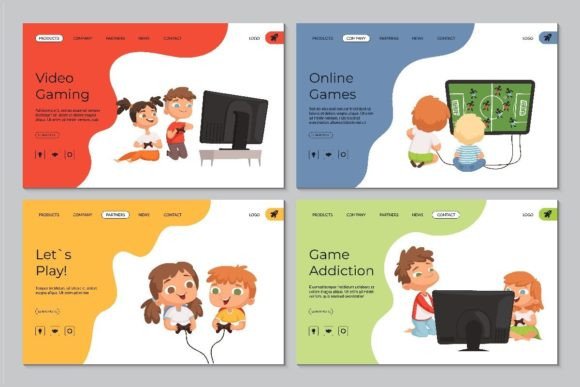
A Gaming Landing Page. Kids with Video is a dedicated web page built with specific intent. It leverages visual elements like cartoon children vector banners and illustrations of friends playing with joysticks to create an immediate, relatable, and age-appropriate environment. Its core function is to capture attention, communicate value, and guide visitor action—whether that's downloading a game, signing up for a parent-controlled account, accessing educational gaming content, or learning about safe play practices. Crucially, it integrates video content to demonstrate gameplay, showcase features, or deliver key messages in a dynamic format that resonates with a visually-oriented demographic.
Beyond Aesthetics: Alignment with Macro Trends
The relevance of this specialized landing page format is inextricably linked to larger shifts in technology, consumer behavior, and societal concerns.
Firstly, the professionalization of the children's digital content market has exploded. No longer a niche, it's a major industry segment with stringent expectations for quality, safety, and engagement. Brands and indie developers alike must communicate their product's merits and safeguards clearly to a dual audience: the child who seeks fun and the parent who seeks assurance.
Secondly, we are witnessing the normalization of gaming as a lifestyle and learning tool for younger generations. Video games are integrated into educational curricula, social connection, and creative expression. Marketing these experiences requires a tone that balances excitement with responsibility, a balance a well-crafted landing page can achieve.
Finally, the ongoing discourse around screen time, digital wellness, and potential addiction makes transparent communication mandatory. A landing page for kids' gaming must address these concerns proactively, framing the game within contexts of moderated play, learning objectives, or positive social interaction.
Why Attention is Focused Here
Professionals across marketing, product development, and UX design are paying acute attention to this format for several compelling reasons.
- Conversion Efficiency: In a crowded market, a targeted landing page cuts through noise. By focusing solely on a specific game or gaming service for kids, it removes navigation distractions and funnels interest directly toward a desired action, improving campaign ROI.
- Trust Building: Parents are cautious consumers. A landing page that uses friendly, non-threatening imagery (like cartoon vectors), clearly presents content ratings, features videos of actual gameplay (not just hype), and links to parental control information acts as a trust signal. It demonstrates the creator's awareness of and respect for their concerns.
- Market Differentiation: Generic app store descriptions fail to tell a nuanced story. A dedicated page allows creators to articulate their game's unique value—be it its educational core, its cooperative multiplayer focus, or its creative sandbox mode—connecting with specific family needs and preferences.
The Evolution of Needs Driving Relevance
The expectations of the end-user—both child and parent—have evolved, demanding more sophisticated digital interfaces.
- Information Density with Clarity: Parents seek comprehensive information quickly. They expect to see age appropriateness, cost structure, device compatibility, and safety features immediately, all presented in an easy-to-scan layout.
- Demonstration over Description: A static text description of a game's mechanics is ineffective. Short, embedded video previews showing the game in action are now a minimum expectation. This meets the child's desire to see the fun and the parent's need to assess content.
- Integrated Context: There is a growing preference for seeing the product within a broader, responsible framework. Landing pages that connect the game to resources about balanced play schedules, online etiquette, or supplementary learning materials answer modern parental workflows.
Practical Applications and Observations
In practice, effective Gaming Landing Pages. Kids with Video manifest in various forms, each tailored to a strategic goal.
An educational game developer might use a landing page featuring a video tutorial of a math puzzle game within the gameplay, alongside bullet points highlighting curriculum alignment and a testimonial from a teacher. The cartoon banners would reflect a scholarly yet playful theme.
A subscription-based family gaming service would likely focus its page on video montages of various games on the platform, emphasize the single, parent-managed account payment model, and use illustrations showing diverse groups of children playing together to promote social value.
Even a non-profit advocating for healthy gaming habits could utilize this format. Their landing page might use animated explainer videos about setting time limits, paired with illustrations of kids enjoying both digital and outdoor play, driving visitors to download their guide for parents.
The common observation across successful implementations is the seamless blending of appeal and accountability. The visual design attracts the child's interest, while the structure and ancillary content address the adult's due diligence process.
Connecting to Larger Developments
The importance of this landing page concept is amplified by two overarching digital developments.
First, the rise of privacy regulations and ethical design standards (like COPPA compliance in the U.S.) makes transparent data practices a legal and ethical necessity. A landing page serves as a prime venue to clearly state privacy policies and data handling practices for young users, building compliance into the user journey from the first click.
Second, it connects to the ongoing maturation of performance marketing. As targeting capabilities grow, the ability to serve a hyper-relevant ad (for a children's puzzle game to parents of 8-year-olds) to a perfectly tailored landing page is the pinnacle of efficient conversion. The landing page is the crucial counterpart to precise ad targeting, completing the circuit with a context-perfect experience.
The Forward-Looking Perspective
The trajectory for Gaming Landing Pages. Kids with Video points toward greater interactivity and personalization. We can anticipate integration of interactive elements that allow for limited, safe game previews directly on the page, or video content that dynamically adjusts its messaging based on referral source (e.g., a parent-focused blog vs. a child-friendly YouTube channel).
Furthermore, as artificial intelligence and machine learning tools become more accessible, creators will leverage them to generate variations of these landing pages—automatically adjusting imagery, video highlights, and copy emphasis to test resonance with different segments of the family audience.
Ultimately, this specialized tool represents a recognition that marketing digital products to children is a unique discipline. It requires a dual-lens perspective, a commitment to ethical presentation, and a mastery of concise, visual communication. The Gaming Landing Page. Kids with Video is the embodiment of that recognition, transforming a simple web banner template into a strategic interface for engagement, trust, and responsible promotion in the digital playground.