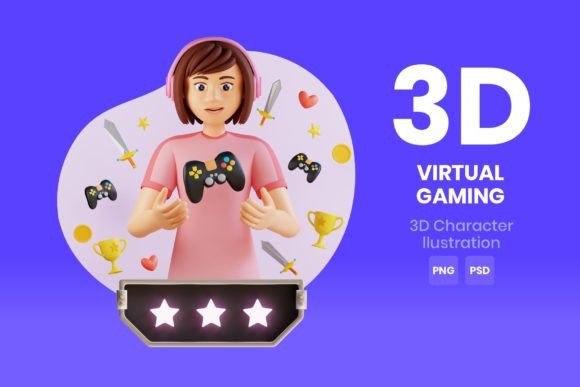
The Digital Canvas: The Strategic Power of High-Quality Virtual Gaming Character Illustration
In the sprawling ecosystem of digital media and interactive entertainment, the visual representation of a character is often the first and most enduring point of connection. While the term virtual gaming 3d character illustration might seem niche, it represents a critical confluence of art, technology, and commerce. It describes the specialized process of creating three-dimensional character models, not just as functional game assets, but as meticulously crafted visual icons. These illustrations are born from the intersection of artistic vision and technical precision, resulting in assets like high-quality renders in 4K, PNG transparent files, and layered PSD files that serve purposes far beyond the game engine.
Beyond the Game Engine: Defining a Multifunctional Asset
Virtual gaming 3d character illustration transcends its in-game application. At its core, it is the practice of producing a standalone, high-fidelity visual representation of a game character, optimized for use across multiple platforms and media. This is distinct from the lower-polygon, real-time models used within a game. Instead, it involves creating a detailed 3D model, often using software like ZBrush, Blender, or Maya, and then rendering it at ultra-high resolutions like 4K. The final outputs are purpose-built: a PNG transparent file allows the character to be composited seamlessly onto any background for marketing, merchandise, or web use, while the provision of PSD files offers a layered, editable format in Photoshop, granting creators unparalleled control over post-processing, color grading, and element isolation.
This approach turns a game asset into a versatile digital commodity. It acknowledges that a character’s value is not confined to its interactive role but extends into branding, storytelling, and community engagement.
Market Resonance: Why High-Quality Character Renders Command Attention
The demand for premium virtual gaming 3d character illustration is driven by several converging trends across professional and creative landscapes. The visual identity of a game is now its most potent marketing tool, with characters acting as the flagship. A high-quality render in 4K serves as the cornerstone for key art, trailer visuals, and storefront assets, directly impacting conversion rates and pre-launch hype.
The Creator Economy and Content Scalability
For streamers, video creators, and community managers, these assets are essential production tools. A PNG transparent file of a popular character can be effortlessly used in YouTube thumbnails, Twitch overlays, social media banners, and merchandise designs, ensuring brand consistency and visual appeal. The availability of a PSD file further empowers creators to adapt the asset for specific campaigns or thematic content, adding custom text effects or integrating it with other graphic elements without needing specialized 3D software.
Business and Branding at the Digital Frontier
Entrepreneurs and marketers in the gaming space recognize that a strong, iconic character is a brand unto itself. Investing in a top-tier virtual gaming 3d character illustration provides a reusable visual library. This library can fuel everything from advertising campaigns to physical product design (like apparel or collectibles), website development, and investor pitch materials. The character becomes a recognizable symbol, and the technical quality of the underlying assets—the 4K resolution ensuring crispness on any display, the transparency allowing for flexible placement—determines its applicability across touchpoints.
The Evolution of Creative Workflows and Professional Expectations
The relevance of this specialized service is also a direct response to evolving professional workflows and heightened expectations. The line between game development, marketing, and ongoing community support has blurred. Development teams, especially in indie or AA studios, often operate with lean resources. Having a set of production-ready, high-fidelity character illustrations separate from the in-game models allows the marketing or publishing team to work independently and agilely, without constantly requiring support from the core engineering or art team.
Furthermore, the expectation of quality from audiences is universal. A fan seeing a character on a website, a poster, or a t-shirt expects the same visual fidelity they experience in-game trailers. A low-resolution or poorly composited image can undermine perceived value. Hence, the baseline has shifted: a professional presentation now necessitates assets like 4K renders and PNG transparent files to maintain that quality across all public-facing mediums.
Technology Democratizing Access, Raising Standards
Advancements in rendering technology and the accessibility of powerful graphic software have raised the bar for what is possible and expected. Real-time rendering engines and cloud compute can now produce photorealistic or stylistically perfect high-quality renders relatively quickly. This technological capability has trickled down to the service market, making it feasible for specialists to offer these high-end illustrations to clients who may not possess the internal hardware or expertise. The deliverables (PNG, PSD) are consciously chosen for their interoperability with the wider suite of tools used by designers and marketers.
Practical Applications: From Asset to Application
The utility of a well-produced virtual gaming 3d character illustration package is best understood through concrete examples.
- Cross-Promotional Campaigns: A game studio partnering with a beverage brand can use the transparent PNG of its protagonist on limited-edition cans, website collaborations, and digital ads without costly custom design work for each format.
- Dynamic Social Media Engagement: A community manager can use the layered PSD to quickly create seasonally themed artwork—adding holiday elements or event-specific text—to keep social channels fresh and engaging, directly driving interaction metrics.
- Merchandise Prototyping and Production: A clear, high-resolution render is the essential first step for designing and manufacturing figurines, posters, or apparel. It provides the exact visual reference needed for manufacturers and satisfies the quality demands of collectors.
- Investor and Media Pitch Materials: For startups seeking funding or press coverage, a stunning 4K character render in a pitch deck or press kit conveys professionalism, artistic vision, and market readiness far more effectively than in-engine screenshots.
Connecting to Larger Developments: The Character as a Persistent Digital Entity
The significance of this trend connects to a larger evolution in digital culture: the decoupling of content from its original container. A game character is no longer an entity locked inside a software application. Through NFTs, metaverse aspirations, cross-media storytelling, and brand extensions, characters are becoming persistent digital entities with lives outside their native games. The need for a high-quality, portable, and editable visual representation—the very definition of a premium virtual gaming 3d character illustration—is foundational to this evolution.
It enables the character to exist authentically on a blockchain marketplace as a digital collectible, to be imported into a virtual meeting space, or to be featured in an animated web series. The technical specifications, like a PNG transparent file for easy integration into diverse environments or a PSD file for iterative adaptation, are not mere conveniences; they are the prerequisites for this multi-platform existence.
A Forward-Looking Asset
In a professional context, procuring such an asset is a strategic decision. It is an investment in a flexible, future-proof visual resource. As platforms evolve and new media opportunities emerge—from augmented reality experiences to next-generation social networks—having a character in this malleable, high-fidelity format ensures readiness. It removes technical barriers to participation in emerging trends, allowing creators, entrepreneurs, and marketers to pivot and leverage their core intellectual property—the character—wherever attention and opportunity migrate.
Ultimately, the focus on virtual gaming 3d character illustration and its specific deliverables like high-quality renders in 4K, PNG transparent files, and PSD files reflects a mature understanding of the digital asset lifecycle. It recognizes that in today’s landscape, a character’s first job is to be compelling in-game, but its enduring role is to be a versatile, high-quality visual anchor for everything else that builds upon that initial creative vision.