The Missing Piece in Your Amazon KDP Puzzle: Gaming Composition Notebook Keywords
You've poured your creativity into designing beautiful books. You've uploaded them to Amazon KDP with high hopes. Yet, the dashboard shows a stark reality: zero sales. It's a frustrating scenario many publishers face. The truth is, in the vast digital marketplace of Amazon, a good design is only half the battle. Without the right signal to guide customers to your product, it remains invisible. That signal is a keyword.
Why Your KDP Books Might Not Be Selling
Think of Amazon's search engine as a crowded, noisy room. Customers are shouting what they want—things like "Gaming Composition N.B for Kids Keywords"—and only the products that answer back clearly get noticed. If your book listing isn't tuned to hear and respond to those specific shouts, it sits silently on the shelf. Many publishers focus solely on cover art, interior layout, and description copy. These are vital, but they are the presentation. Keywords are the navigation system. They are the fundamental data that connects a buyer's intent to your product's existence.
High-competition keywords are like trying to shout in a packed stadium; your voice gets lost. Conversely, low-competition, specific keywords are a direct conversation in a quiet space. This is where understanding niches like Gaming Composition Notebook for kids Keywords becomes a powerful strategy. It's not about guessing what might work. It's about using data to find the precise phrases that real customers are using, which have manageable competition, and aligning your book with them.
The Power of Data-Driven Keyword Selection
Moving from intuition to analysis changes everything. Effective keyword research for Amazon KDP involves looking at several layers of data:
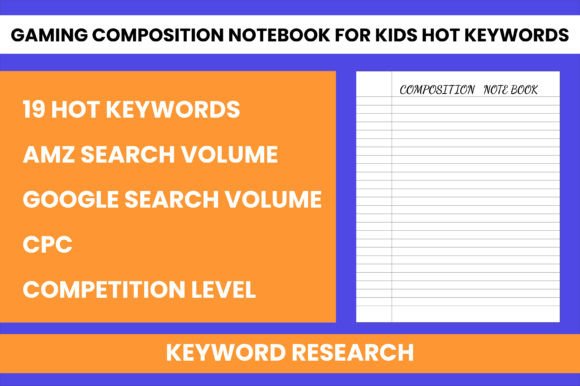
- AMZ Search Volume: How often is this term actually typed into Amazon's search bar? This tells you the direct demand on the platform.
- Google Search Volume: While Amazon is your storefront, search trends on Google can indicate broader interest and popularity of a topic, which often translates to Amazon searches.
- CPC (Cost Per Click): Typically used for advertising, this metric can hint at the commercial value and competition level of a keyword. Higher CPC often means more profitable, competitive niches.
- Competition Level: This is critical. How many other books or products are already targeting this same keyword? A low-competition keyword with decent search volume is a golden opportunity.
A robust keywords data analysis file, such as an Excel sheet detailing these metrics for specific niches, transforms your publishing from a creative hobby into a strategic business. It validates your ideas. It shows you, for example, not just that "kids notebook" is popular, but that the more specific phrase Gaming Composition N.B for Kids Keywords has a measurable, actionable audience with fewer competing titles. This is how you find lanes where you can actually compete and win.
Integrating Keywords into Your KDP Workflow
Finding the right keywords is the first step. The next is weaving them seamlessly into your book's Amazon presence. This isn't about clumsy repetition; it's about semantic alignment.
Your book's title is prime real estate. If your data highlights "Gaming Composition Notebook for kids Keywords" as a strong, low-competition term, consider incorporating a natural variation into the title. For instance, "Gamer's Log: A Composition Notebook for Young Gaming Fans."
The subtitle and description are where you can fully articulate the keyword's intent. Describe the book's purpose using the language your research uncovered. Explain how this notebook is designed for kids to write down game strategies, character ideas, or level designs, directly servicing the need behind the keyword search.
Most importantly, you must place these keywords strategically in Amazon's backend keyword fields. This is the technical core of SEO for KDP. Use the precise phrases, their variations, and related terms from your data analysis. Don't waste these slots with single words or irrelevant phrases. Every slot should be informed by your research.
From Keywords to Niche Discovery
A deep keyword analysis does more than optimize a single book; it opens doors to new niches. By examining a set of related keywords, you see patterns of demand. You might discover that alongside gaming notebooks, there's search volume for "coding journals for children" or "esports planner keywords." This data can inspire your next publishing project, creating a cohesive portfolio of products that serve a growing, specific audience.
For example, mastering the Gaming Composition N.B for Kids Keywords niche might reveal that parents and young gamers are looking for more than just a blank notebook. They might want pages with prompts, gaming-related artwork, or sections for tracking gameplay hours. Your data validates the core idea and can spark innovations within that idea, allowing you to create a product that not only matches the search term but exceeds the expectation behind it.
Practical Benefits and Long-Term Considerations
Adopting a keyword-first approach offers immediate and lasting advantages. The most obvious is increased visibility. Books aligned with validated, low-competition keywords have a significantly higher chance of appearing on the first page of Amazon search results. This front-page placement dramatically increases the chances of clicks, which leads to sales.
It also builds a sustainable foundation. Rather than chasing ever-changing trends or copying what's already popular, you are building expertise in a defined area. Publishing a series of books around a cluster of profitable keywords, like those related to gaming composition for kids, establishes your brand as a authority in that micro-niche. Customers who find one book through a specific search are more likely to buy your related titles.
Before you choose keywords, consider these factors: the authenticity of the book to the keyword (don't force a mismatch), the longevity of the niche (is it a fleeting trend or a growing hobby?), and your own capacity to produce quality content for that niche. The best keywords marry market opportunity with your genuine ability to create a great product.
In the end, the goal is satisfaction for both the customer and the creator. The customer finds exactly what they searched for. The creator sees their hard work rewarded with sales. By starting with a solid keywords data analysis—by knowing the exact search volume, competition, and value of terms like Gaming Composition Notebook for kids Keywords—you move from hoping for success to architecting it. You give your beautifully designed books the voice they need to be heard in Amazon's crowded room.